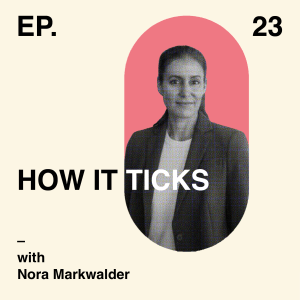

Whats Next After Protesting, A Guide To Systemic Change | Nora Wilhelm (#32)
Episode Summary
My guest today is Nora Wilhelm, a systems change strategist, social innovator, and co-founder of Collaboratio Helvetica. Her work focuses on helping people and organizations understand the complex systems that shape society and what needs to happen to implement real, lasting change.
Expect to learn about the magnitude of global problems and why traditional approaches often fail. We discuss what it means to think systemically, the difference between simple, complicated, and complex problems, and how individuals can still make a meaningful difference. We also discuss Nora’s personal journey in building Collaboration Helvetica, her views on the effectiveness of activism, and why she remains hopeful about our capacity to change complex systems for the better.
Meet Nora Wilhelm
Nora Wilhelm is a systems change strategist, social innovator, and co-founder of Collaboratio Helvetica. As a well-regarded voice in the field, her work focuses on cultivating cross-sector collaboration to address systemic challenges. Having faced her own struggles with burnout, she is also a passionate advocate for inner resourcing and finding a sustainable way to contribute to a more just and regenerative future.
Connect with Nora
- Website for Systems Change Work: https://www.norawilhelm.org/
- Inner Work & Creativity Project (The Well): https://www.norawilhelm.org/the-well
- LinkedIn: Search Nora Wilhelm
Resources & Workshops
Nora has provided the following free resources for listeners who want to apply systems thinking or find their purpose:
- Free Systems Change 101 Workshop: Learn more about systems thinking and apply tools to your cause. https://www.parayma.co/sc101
- Free Find Your Purpose 101 Workshop: For anyone looking to identify and align with their unique contribution. https://www.parayma.co/fyp101
Full Transcript
Mike: [00:00:00] Can we start off by you telling me what is the difference between a systemic problem and a regular problem?
Nora: So say for example, you’re looking at the best way to do your bookkeeping. It’s probably not the best idea in the world to be super innovative when it comes to how you do your bookkeeping, right? Bookkeeping is something you wanna stay within the square meters of what is legal, of what is considered good or best practice, and you wanna make sure to solve this problem of bookkeeping as simply as possible, right?
You will try to make it as straightforward and as useful as possible for anyone who does need the results of your bookkeeping process. And usually you can have a pretty linear relationship between I will sit down to do this bookkeeping using this template or using this software and the output that comes at the end of it, right?
Like it’s pretty predictable. You can plan it, you can control it,
Mike: I.
Nora: you can get trained for it, get a degree in that. So that could be considered a [00:01:00] problem that depending on the size, of course, of the organization you’re looking at, but in general, it’s a problem that is considered simple according to the FIN model.
So a model that helps us understand what kind of setting are we operating in, and then adjusting the way in which we act based on. Now if I said, Hey Mike, let’s try to fly a rocket to Mars. Now, that would be a complicated problem, right? That would be something that requires a lot of expert knowledge, typically many different kinds of expertise that really needs to come together to solve this particular problem.
And we will maybe, based on all of that expertise, put together, prototype, we will try it, it may work, it may fail, right? And arguably there might be people who disagree in how to best solve it, right? Some people may say, I have an idea for a rocket that’s completely different, and it’s very in, and there’s potential value.
If you’re interested in getting to Mars, which I am not personally, but for the sake of this example, you could get together and explore a new way of doing that, right? So that is a complicated problem. So there is not a guaranteed relationship between what you do and the result because there are some [00:02:00] unknowns and you need to figure some things out.
But as long as the science, the sound, and you do the work of bringing the expertise together, usually you can replicate it, right? You can say we build a rocket once this time, if we build it again, and this time. In this way again, then probably we will have the same result at the launch. Now, a complex issue is an issue where none of these rules apply, you may intervene once and get a different result.
You may intervene again in the same time, just, a month later or a year later and get a completely different result. You do not have this relationship between cause and the action that’s caused the results. It’s much more complex than that, right? Hence the sense of complexity the problem typically arises when we are in a complex context.
For example, take a natural ecosystem. It’s very complex, right? And we have some science and some knowledge around how a certain ecosystem, say a forest works, but we keep learning more, right? And we keep discovering how limited the human view actually is, right? We were like, oh, a forest. Yeah, it’s a [00:03:00] bunch of trees.
They stand next to each other and now we’re learning that they communicate with each other, right? That there’s mycelial network underneath the earth that we don’t see that are very important for sharing resources and information amongst the trees, et cetera. So this just goes to show that usually our view on something that is complex is by definition, always limited. And there’s an example actually from your home country, if you don’t mind me picking on you for a sec. You must be familiar with the aga toad.
Mike: enlightened me,
Nora: this massive toad that, that has a large chunk of the Australian, island. And it happened because last century there was a beetle plague that was eating the sugar cane.
And sugar cane was a very
Mike: In English. It’s called a, Cane toad.
Nora: There you go.
Mike: There we go.
Nora: So we call it the aga toad. And I mentioned this example often when I have a speech or something like that, right? So they’re like, okay, beetle cane, problem with this beetle that eats our sugar cane. Great idea. Toad will eat beetle, right?
Except toad did not eat beetle. And not only did it not eat the [00:04:00] beetle, like it had no natural predators right across the whole continent. And it just spread. And not only does it not have any natural predators, but it’s actually so toxic, poisonous that if a predator local one were to eat it, it would most likely die from doing so.
So now it’s this slow, overtaking, of the continent that happens. Due to someone that had a linear thought process, right? Like they thought, oh, this is the problem. Let me solve it in this way. But they didn’t account for the complexity of the ecosystem and nor did they do any testing to be fair.
It could have been something that would be a bit easier avoided. So yeah, so that is the difference between a challenge that is complex or systemic could be another way that we use for it. And a challenge that is complicated versus a challenge that is simple or straightforward.
Mike: So could you say it’d be a combination of number of variables and level of knowledge required to solve it?
Nora: Yes. That could be one [00:05:00] way to look at it, but there’s a number of different ways to, approach the question. For example, there are people who say that challenge, whenever you think you’ve solved the challenge, you actually have just revealed the deeper challenge. So you try to address the problem, but then the deeper root cause
Itself and then you have to go after that. Another kind of definition that people use is that complex challenges. The moment you’ve intervened, you’ve also changed the system. You’ve already had an impact, whether it was what you wanted or not, whether you’ve solved challenge or not, you already had an impact just by you intervening. Whereas if I’m doing my bookkeeping and I, I don’t publish it, I just do something on my computer, like that’s not gonna have consequences for anyone else. Whereas if the complex challenges, for example, migration or racism or inclusion or women’s rights, right? The moment I intervene as me, even with the best of intentions, [00:06:00] I will do something to the system, right that is gonna have a ripple effect, most likely something that I am unable to predict
Other people say that complex challenges in essence can never be completely resolved. They can be differently negotiated, we may look at this and as a society or as a group of people say, this used to be normal. We don’t think this should be normal anymore. Like you can say women not having the right to vote. You can say slavery, right? You can name any sorts of examples nowadays.
Maybe it’s throwaway culture and plastic, right? Where collectively we were like, oh yeah, that’s pretty normal that I just buy something. It’s wrapped in plastic, and then I throw it out. And maybe a hundred years from now, people were like, our ancestors were insane, right? Because it’s not normal anymore. So the view that we have on challenges, especially if systemic challenges is very normative, right? It’s based on the values that we hold. So that’s another way that you could look at it. So yeah it’s a big field.
Mike: It’s interesting. It [00:07:00] reminds me, I read this, great book, called The Body, and it talks about how. In the, I guess it would’ve been the late fifties now. Smoking was a regular thing and doctors would say, yeah, this is fine. This is totally healthy.
And it wasn’t perceived as a problem. And now in hindsight we look back and say, this is the stupidest thing ever. How could you possibly think that’s a good idea? I do wonder, in 50 years time what people are going to see saying about 2020 something. How stupid were those guys doing those things? Then how could you possibly think that drinking out of water bottles is a good idea?
Nora: For sure. Yeah. And the sad thing is that we can often trace back some of these things to who really benefited from them. Some disasters or problem problematic situations are like a result of circumstances, right?
There’s a storm, there’s a frost, there’s a drought. Something is out of our control and it just happens and we have to deal with it. for example, the plastic right issue that we have was completely engineered, right? In the sense that there were industry players that saw, oh, [00:08:00] if we move away from the completely circular, by the way, model of glass, right? We would make such a bigger profit margin. We could get our products to places where we can’t get them yet, right? So let’s just push for that. And then meetings were had where people were like, but don’t you think that like the average consumer is gonna mind like just throwing away, right? A bottle after using it. And they were like, we’re gonna call it recycling, right? Like you can actually trace back some of these developments to knowingly. Very much specifically implement something so as for something to be normalized. And if you look at climate change, for example too, we know that the biggest polluters, we know that the petrol industry have known for decades, right?
About global warming and about the consequences. And they have specifically decided not just to not do anything right, but to infiltrate climate negotiations and to put out propaganda to confuse and muddy the waters. So we will be slower to [00:09:00] react. So sometimes when people look at humans and they’re like, oh, are we just a parasite?
Are we so terrible? Are we so shortsighted? I’m like sometimes we are and we need to face that. And in many other cases you can trace the problem back to a handful of people who saw that there was bank to be made right,
Big private interests in keeping us uninformed or misinformed.
Mike: Could you look at, I agree with you to a sense, but I also want to also attempt to give people the benefit of the doubt. Could you also say that plastic is one of the, or single use plastic is one of the 20th century’s biggest and best innovations because it allowed the whole world to be able to, it’s a great tool.
It is cheap, it is quick to make, you can use it for a million different things. And at the time of creation, the world did not have the knowledge it has today in the impact it has. And so small companies, small business, or even big ones thinking this is gonna be a great product. Yes, it’s gonna make us a [00:10:00] lot of money, but it’s also because it’s a great product.
And the thinking of, yeah, I don’t care about how this destroys the world, isn’t really part of their thinking. That is just something we see in retrospect.
Nora: In some cases, yes. What I specifically said is not that these people knowingly went on to destroy the world and
Mike: sure.
Nora: us all right?
In the petrol industry, we know that this is the case in the plastics industry. I agree that, unforeseen consequences like whoops, microplastics everywhere, et cetera, et cetera. could we have seen that coming? Maybe not. That’s debatable. But what I said is that they came up with the concept of throw away culture. That’s what they invented,
Right? Couldn’t we convince people that it’s okay to just throw away things? and I. Rather than when I say this, I’m not coming at it from a place of what horrible people.
They are so evil and mean and like this kind of monopoly. Pix two figure who just tries to, to harness all the resources from themselves. Maybe some are like that, but my main point is that [00:11:00] these people are embedded in a certain paradigm of thought as we are, all right? So we are socialized into certain paradigms.
We are told, here’s how the world works, here’s how the economy works, here’s how, women should behave. Here’s how men should behave. Here’s how, like all these categorizations that we are given, right? The story of what it means to be a human being and maybe even a good human being, what success means, right?
What a society does. Like all those things are teachings that we receive from our parents, from our peers, from schools, from the media, et cetera, et cetera. These are all profoundly embedded paradigms. Like the patriarchy is an embedded paradigm. Capitalism is an embedded paradigm. Colonialism is another embedded paradigm. And we are socialized into these without us knowing. It’s like the fish that’s in the water. We are just in the water. We don’t know that it could be any different. This is just the environment that we have. And then only if we, for example, learn about other cultures where they had seven genders, we’re like, what? Seven genders? Like we were always told, right? There’s two and [00:12:00] that’s that. And no discussion a completely different view on humanity and what it means to be human. Or a philosophy, for example, coming from Brazil and fem, a feminist movement there that’s about good living and that’s a life philosophy.
And I’m like, wow. That’s very different from the philosophies that we receive here. And so in that sense, when I, look upon people who have made decisions that have had disastrous consequences for all of us, I do not want to. Point a finger blankly and say that all of them did this knowingly and with like just the intention of looking away from the consequences and for their own benefit. Because maybe if I had been that person, if I had received all of the same teachings and conditioning, maybe the same decision would’ve seemed logical to me, right? So I think the conversation around what paradigms are we coming from? What opinion do I have about nature? Do I see myself as part of nature or do I see myself as [00:13:00] separate? if I’m separate, it’s okay to extract resources and maybe destroy a couple things, right? So all of these things subconsciously influence us so much. So I hold a lot of empathy, right? So we need to call it out when it does happen, has been revealed with the petrol industry. And at the same time, who am I to say that if I would, for example, be socialized into a long line of petrol Barrens, that I wouldn’t act in the exact same way.
Mike: Yeah, some of these bigger systemic problems I can understand. Why? They’re difficult to solve. ’cause some people may not even accept they’re real. If you’ve never swm in the ocean before and you might go, it looks fine to me, I don’t see any plastic. This is not a real problem.
But just take that as an example. I can understand in some circumstances, you could be in denial that it’s a problem. Other ones, there is no possible way any human could agree that we shouldn’t get rid of world poverty. Because everyone can imagine what life is [00:14:00] like being extremely poor.
And you can get pretty good evidence to show that a large population is in poverty. And yet these problems don’t seem to go away.
Or even, and correct me if I’m wrong, they don’t seem to be getting better. They seem to be getting worse. And I hope that’s not true. That’s just my perception. Why does that seem to be the case?
Nora: On one level, things are accelerating now and seemingly getting worse because we are still accelerating ecosystem collapse and global warming, even though we are already seeing its impacts. So this was, for example, astonishing to me, like as a Swiss person. A couple years ago we had floods in the summer, right?
And it was super clear that this was like linked to climate change and people died just in Germany, right? Like I think 60 people died in Germany when a river over flew. And I was like, it’s here, like now we’re gonna get it. And then nothing happened.
Or like recently the village of Blaton [00:15:00] right, was swept. Away or buried under, a glacier that came down. And I’m like, surely now as a collective, we understand, right? Because the hypothesis is always like climate change is hard to tackle because the consequences always seem so far away. They seem to concern someone else somewhere else in the future or in another country, right?
In another part of the world, it doesn’t affect us. And so if I were to put my hand in the fire and I would feel the pain of being burned, I probably wouldn’t put my hand in the fire again, right? But if every time I put my hand in the fire, someone else far away gets burned, or a couple decades in the future, someone gets burned.
Some people are like, oh, either we are not told, we are not aware, we are not informed, or we are so steeped in the narratives that we were socialized into, that we are somehow just, thinking, oh, that’s normal or that’s just how things are. Or somehow, it’s interesting that you brought this example that you think that, for example, for world poverty, people wanna [00:16:00] resolve the problem, right?
My experience, as soon as the challenge is social. Many people actually because of how we were socialized into this narrative of it’s a little bit the American dream applied to us. Pull yourself up by your bootstraps.
If you work hard enough, you can make it right. That’s like what we are told, like in this society, if you work hard, you can make it. And there is a meritocracy. Of course, as soon as you study, as soon as you look into the science a little bit, that’s not fully true. If both of your parents, for example, know how to read, that will set you up for success in life much more than if they don’t. Like your gender impacted, your skin color impacted, there’s so many things that impact actually your trajectory on life. Someone could try twice as hard as I’m trying, and just because I happen to be born in Switzerland, that my skin is white, et cetera. I may achieve things or have opportunities that they never have, and that’s really hard to face and to accept.
But what I’m saying here is that because we are told this narrative and we are given all sorts of strange stories, of other countries and [00:17:00] other places that for some people, if they look at poverty, they just think people are poor out of choice. Like they just think they should just work a little harder,
Mike: Yeah. Yeah. I see. I see.
Nora: And so that’s where like we need to uncover the system and how the system works and the results that are systematically created by this system. I’m overusing the term, but you get my point. Because we tend to collectively overemphasize the individual responsibility. If I win at something, I tend to think, oh, it’s because of me. If someone doesn’t succeed at something, I may think it’s because of them. And partially our own effort, of course, plays a role, right? So this is not to say that I got everything handed to me or that you did, or whoever did, and others are not.
They are always outliers, exceptions, and we all put in effort, but to understand that people are kept in poverty almost by design, and as a result of something that I participate in, [00:18:00] really hard to face, Like even just the technology that we’re talking on.
I buy my tech secondhand, which is still not a perfect solution because someone had to buy it new for me to get it second hand. Yeah, the minds the kids and the people who are suffering and are kept in these circumstances so that we. Can do our work in this case, right? And raise awareness. And so it’s not all bad, but it can be hard to, as an individual connect to the footprint of pain almost. So rather than the CO2 footprint, which I think is also interesting and important, really connecting to the footprint of pain. Who made my clothes, who made my tech? Where did my food come from? How did this animal, if I’m eating an animal feel as it was killed before it landed on my plate, like if you really open yourself up to pain of other people, of animals, of nature that are a result of what we are told is a normal way to live, right?
It’s normal to order something and get it tomorrow, [00:19:00] that’s hard to do because it’s, yeah, you don’t need to be the oil baron, right? You can just be a participant in a system you were taught Is this is normal. There is no problem with any of this.
Mike: So if you do see a lot of systemic problems, such as take your pick, global warming, plastics in the ocean, global conflict, and you see them all, they all bother you. Do you wanna do something about it? It’s an overwhelming amount. Not only ’cause there seems to be so many problems, but also it’s in your face every single day in an ever ending feed.
And what you, what the natural reaction is, I don’t like this, I wanna do something about it. But what you, is the individual supposed to even do other than grab a sign, write something on it, go onto the street and start screaming, I want this to stop. I would like to walk through with you if that’s okay.
Now starting from a person fed up and wanting to do something, [00:20:00] what steps should I take that result in the most useful and productive output.
Nora: Yeah, it’s a big question because as you say, there are so many challenges and Yeah, I always think of this poem by Baron Shire she says, or she wrote, and later it at night. I open the atlass on my lap, I run my hand across the page and I ask, where does it hurt? And it says, everywhere.
Everywhere. And it’s true, right? Like the challenges and the pain and the issues are truly everywhere. There’s also beauty and joy in many places and supporting that. We make space for that. But yeah, so if I’m faced with all of those challenges and I wanna find what is mine to do, what is mine to contribute, I think there’s, to me, two key pieces to this. One is to understand that I am a part of the system, right? So rather than go, oh, this system is [00:21:00] so terrible and someone should change it, and cross my arms and think I’m gonna vote next time for another politician who will change it, or whatever the case may be, right? Myself out of it and thinking that the system is other people somewhere else who need to do something. There’s a lot that we can do by just understanding all the ways in which we are the system, in the sense that we contribute to perpetuating paradigms and co-creating results that we actually don’t want. And that can be hard to do because it means confronting our own habits behavior, maybe something we’ve been doing for years to acknowledge, okay, actually maybe that’s not great and I wanna change. so the key here for me is to not fall into the trap of perfectionism. Not have this idea that okay, either I’m gonna be a model, human being starting tomorrow, perfect on all fronts, sustainability, social equity, everything. Or I’m not even gonna try. That is such a dangerous thing, right?
And I know that sometimes this movement, and also from people who are on the sidelines of the movement, criticism [00:22:00] is so vicious and harsh, right? Like you can have the most outspoken climate activist who’s, really dedicating their life to this cause and doing, everything that they can.
And then once they make a trade off and they fly to a climate negotiation, for example. The outcry. And like I often imagine people in the comments, they’re literally like screaming whilst having like their sausage in the hand and like so angry, but like without able to take a look at themselves,
Mike: Sure.
Nora: that’s always interesting to me, like how much energy do we spend criticizing other people for what they’re doing or not doing? And how much energy am I spending on myself figuring out what I can do? So that’s a general prompt. Like figure out what is it that I can tackle, that I can change? And this will be for every single person, right?
For example, for me to stop eating meat was very easy because I never liked meat. I never wanted it. As soon as I could tell it had been an animal, I just instinctively didn’t wanna eat it. So for me, not a big deal. For other people, maybe culturally or in their family [00:23:00] or taste wise, it was a huge deal. So much harder to reduce their meat intake, for example, me, clothes were so hard. Because I had low self-esteem, I really bought into all of this propaganda, right? That I was never pretty enough, never good enough. And if only I would buy this new shiny thing, then maybe, right? So I did a lot of retail therapy and trying to cope with that insecurity through buying clothes. So for me to stop shopping, that was horrible. Or to buy
And be more mindful about that.
So that’s the whole part around like own behavior that I would say is important because we are all, like I said, part of the system. And then the second part is to find what I call your unique contribution. this is my personal life philosophy that I think we are all here in this time because we have gifts to contribute that will help us navigate what we’re currently facing. I do believe everyone has what I call a unique contribution. And for some people, this may not be in their work life. For some [00:24:00] people, this may be in their family life.
This may be in how they show up as a neighbor, it can be all sorts of things, but my focus is on people that do focus their work on that, right? So they look for their unique contribution in terms of their work. My day, right? My work time. Where can I invest it to make the biggest possible difference, right?
And that goes, I think to your question of like, how do I prioritize if all these issues are important? And so I developed this framework called the seed framework. It stands for self-awareness and visioning, ecosystem awareness, and then designing. And so the point here is that I think to find your unique contribution, it’s really important to know yourself Who am I? What are my values? What are my gifts, my strengths, right? What are the things that I can build on and bring into whatever it ends up being that I will do? It’s really important also that we connect to the vision. Not just fight against what’s going wrong now, but really what are we working towards?
Why are we doing this? What would this good life be that we aspire to and that we hope [00:25:00] all human beings can have across the planet, right? So like that vision, that envisioning part is often. Missed as a step or ignored or discredited, but I think it’s really important. then ecosystem awareness means meeting the world where it’s at, and developing a sense of awareness of what is happening in that ecosystem. So we go through a process of looking from the causes that I really, care about or that kind of stand out to me what is actually going on. And then with systems thinking, you have a number of different tools that you can apply to sharpen your understanding of that. So you can really see, example, if I really care about, say, food waste or the food system in general, in my city, in my context, I can begin to have a look what’s really going on?
Who’s making the decisions, right? Who’s benefiting from the status quo? Who’s underserved in the status quo? Who is trying to address this challenge already and in what ways? And all of that information will then allow me to design my strategy, my role, and my next step. So [00:26:00] basically combining this information of knowing myself really well and knowing the system, the context in which I wanna contribute as well as possible.
And I have a little process which may, we can maybe put in the show notes for your listeners, as a little treaty. But I have a flow chart that helps you anchor your cause at a level at which you can actually address it. many people, when they see these massive issues and the global injustice, et cetera, they think very high level, they suddenly go super meta.
They’re like, okay, how do we reform capitalism? Or how do we stop climate change on a global level? And I often have to encourage people focus on what is actionable for you? Where is your sphere of influence? Where can you really make a difference? And maybe that’s in your company, maybe that’s in your city, in your neighborhood, right?
It can be all sorts of places. For some people it’s national or beyond. But I’m much more interested in people who are driving profound change at small scale than people who [00:27:00] keep just talking in theory about what we should do on a global level, right? Which we
Be doing for the next 10 years, we are not gonna see any change. So yeah, I really wanna encourage people to if they feel called to really make their unique contribution and wanna drive transformation to find where they are really well positioned to make a difference right now. ’cause I believe there is that gift
Mike: If we take your example of, the vicious cycle, which is fast fashion, and we say, okay, yep, I am going to be very responsible with how and where I buy my clothes from, but it’s not enough. This is the thing that I’m personally attached to. This is where I wanna spend my energy. Could you maybe, and maybe you could choose a different example, but could we walk through what a practical step by step would look like for someone living in Switzerland to actually, go to provide valuable, contribution to a particular, systemic problem like fast fashion.
Nora: for sure. So for [00:28:00] example, if I’m really committed to this issue of fast passion, I would still do the step of self-awareness. So I would identify my values, my strengths, my skills that I can really bring to the table, my passions, because sometimes there’s. Things that we don’t think of as professional, but they’re actually a great tool for change.
Like for example, maybe I’m really passionate about making musics and I read songs. You could write the next hit, that is speaking to this issue. Who knows? So also be open-minded about what constitutes a contribution. So that’s why I include passions and causes. We already got that covered.
It’s gonna be fast fashion, right? As an issue. then we move to the next step of envisioning like what would a future in which this is solved look like? What is the alternative? What is the more beautiful future, the more regenerative and just future that you’re really aiming for? Why are you doing this right?
What’s driving it? And from there we would go better understanding the system. Itself. So we would have a look how the sy [00:29:00] this system work, who are the players, right? And pretty quickly you would find, example, the big global retail chains, right? Like h and m and Zara, et cetera, et cetera. You would probably find that there are, factories in different countries that are maybe subseries or that are independent, right?
Like there, it gets a little bit out of my expertise how this actually works. But if this person is very expert in this, they will know exactly what I’m talking about. We have regulators, right? So then the question is who’s making these rules? Is it like the World Trade Organization? Is it some kind of EU regulation? Are there standards that need to be respected? If yes, who decides those standards? Are any labels relevance that we wanna consider? Kotex or organic, et cetera, et cetera. And we will really try to map out that system. I have a template for that, which I’m also happy to put in the show notes
To better understand the mechanics of the system.
And the reason why we do that to not just jump in at the first thing that we think is a problem, right? So typically, and [00:30:00] an easy example here is plastic in the ocean. People are like, oh, plastic in the ocean. Let me do a beach cleanup, because that’s what you see the plastic that’s laying on the beach, right?
That’s an obvious issue, but it does take some more thinking, reflection, and preparation to away from single use plastics entirely, which would be effectively resolving the problem, right? The beach cleanup doesn’t long term resolve the problem. So in the same way in the textile industry, we would try to look at how is this system actually put together? What are the most problematic signals, right? For example, you’ve probably seen. These massive mountains of clothes that are just dumped in different countries on the African continent for the most part, right? Way more than they could possibly handle or absorb, et cetera. And we are told these are donations, right?
So you would uncover like all of these places, you would uncover the places where factories violate human rights. You would uncover the rivers that are polluted. You wouldn’t cover the resources used for this, right? You wouldn’t cover all of that. And you would also enc uncover who decides.
So who makes the [00:31:00] rules and who really benefits currently in this situation? So who is invested as per what we were discussing before into this not changing, right? Because we could ban fast fashion. could say if you’re a fashion brand, you can do two seasons a year tops. That could potentially be a law that we make, right? So who is very interested in this law? Never ever happening. And you will find right shine, you will find all of these kind of dropshipping and et cetera. So you would do that analysis and then really importantly, you would bring it to a context that is actionable for you. So say I’m a person based in Switzerland, unless I happen to be some kind of very visible thought leader that has maybe European influence or global influence, I’m elected in the, I dunno, European Parliament or in the UN or some kind of institution, most likely it’ll make sense to zoom a little bit, right?
Like to scale down my thinking to say the Swiss context. a specific focus or [00:32:00] maybe even my city potentially, depending on the case. there it already depends, right? Do I live in Sun Island, which has a history with the textile industry, right? That slowly left Switzerland, but some essence of it is still there. Am I in Zurich, which is has this startup environment, many like and secondhand shops and this kind of, like there’s a scene there of things already happening. Am I in up cell where no one maybe is thinking about this, or actually some local person is right? Et cetera. So my context becomes really important and then I would try to narrow it down to that sphere where I can actually make a difference.
So my city, my neighborhood, maybe the country. And then from there I would think knowing that this is now my system, so say it’s my city, would go through this mapping process again and would say, okay, what h and m does in Bangladesh. Outside of my sphere of influence, what, this institution at the European level does outside of my sphere of influence. how do the people in Zurich consume [00:33:00] within my sphere of influence? How are secondhand shops organized in Zurich, within my sphere of influence? What rules exist in Zurich, right? Do we have any laws, for example, there, there was just a success recently to ban advertising in Zurich as a measure to try to stop encouraging people to over consume systemically, right? So I would see okay, what really exists, specifically in my context in Zurich, who’s already trying to solve this issue, right? Like, how many associations already exist? How many thought leaders, how many politicians regularly speak about this in the Zurich Parliament, et cetera, et cetera. And from that mapping, I would begin to see potential intervention points. So I would maybe see, huh, in Paris, they put a law we don’t have yet. How about I work with these stakeholders to push for this particular law to come to Zurich? Or I could say, I really see that the secondhand stores are already struggling. And I think there’s an opportunity here. And maybe if you’re a [00:34:00] business type of person, you may do a social enterprise around that, like rework, right?
For those who know it. If you’re an academic, you may say, let me help my students study the challenge and come up with little projects around it, right? So depending again on who you are and what your skills are, what you end up doing will be very individual. and that’s important. So I think it’s really important that we consider both what does the system need?
Like what’s the problem and what am I really well positioned to do? Because if I set myself on a path, forcing myself to do something, because I think it’s the most important thing to do, likely I will end up in a burnout,
Mike: it.
Nora: that it’s a path that also nourishes me back as much as possible.
Mike: It does sound like really. For you to be able to tackle this problem in the best way you can. You have to become an expert in the problem. And it sounds like your approach is a framework to become an expert. [00:35:00] ’cause it’s an overwhelming amount of things which you have to learn. And these are the steps you take to becoming that expert.
Would that be a fair way to summarize it?
Nora: I think so most of the people who come to me with this question, usually they end up working on a topic that they are already expert in. So maybe this person used to be a fashion designer, And is I now see the problem. I wanna contribute. What can I do? And. There’s only few cases in which it makes sense to choose a cause that you really have no expertise on.
So my flow chart basically goes are you personally affected by this issue? So for example, if I was, say, from the family of someone who, was working in a sweat shop. I would be very well positioned to talk and work on this challenge. Or have you had firsthand expertise with this issue?
So have you worked in the industry for example, or have you extensively studied it, right? Some people do long degrees and they really know about something, et cetera, et cetera. So what is your proximity to the challenge? And it’s true that you really, what you point out is that I [00:36:00] think we ideally pick a cause that we have some proximity to either like a legitimacy, because we are part of the group, right?
We are advocating on behalf of the issue from a place of, I’ve experienced this myself, or we have really a lot of experience and expertise in it. the person would not have any expertise, most likely I would work with them to find a challenge where they do have more proximity. And in few cases it would make sense to say, okay, you know what, this is really your passion. Let’s take the time to become an expert and to study this. Because if, we are saying we wouldn’t wanna be the people who import the ATO again, right? We don’t wanna be the naive people who come in I’m gonna solve this. And not having any context, any knowledge, having not done that process to really understand the system.
And that’s important to be mindful of. Yeah.
Mike: You’ve touched on it a little bit already, but what are the. Really wrong ways to go about this that people should be [00:37:00] mindful of to try to catch themselves before doing it for too long.
Nora: So there’s typical pitfalls in how we think in how we act and in also in what we don’t wanna look at. And so in how we think. One of the pitfalls is just immediately thinking we have the solution, right? Problem, solution. And I would put this under linear thinking, as a general kind of fallacy, but also sometimes ego-driven thinking, right?
So as soon as we want to be the one who solves this issue, my ego has taken such a space that actually, for example, collaborating with someone who shares the same goal becomes almost impossible because you’re not my ally, you’re my enemy
Be the one who solves, right? And this I’m, characterizing a little bit.
But this happens in many places in the movement actually, right? Because we do compete sometimes for funding, for awards, et cetera. so in how we think, definitely watch out for linear thinking. Watch out for the [00:38:00] ego, taking a lot of space, watch out for, assumptions, especially when we are not part of the group that we are trying to support or to address with what we do. We make so many assumptions, right? It’s like we can’t really help ourselves. It’s how we navigate the world. And so if we’re not careful and if we don’t make a conscious effort of working with the people that we are seeking to support, so say for example, I dunno, I, find out that there is, this many people who seek asylum currently living in Zurich. And I’m like, oh, these people are underserved and I hear certain things. And if I just come at it, assuming what they need and I design a project or an intervention based on what I assume they need, like I’m, I may already be way off, right? So these are some of the typical pitfalls and things I would be like, careful.
Let’s try not to do that. Or another one that I’ve already mentioned is trying to go too large scale, right? Oh, I care about the world. I wanna solve global climate change. Or let’s end hunger on a global scale or right. Like these tendencies to [00:39:00] go very big, which will end up either making me very depressed, burned. just not very relevant I stay in this theoretical space. So that’s around the thinking piece. And then in how we act, reflecting what I said before, but there needs to be a certain humility and openness to learning in how we act and how we show up. Because I assume that I already had the answer and right, and what I’m gonna do is gonna solve the problem, I’m not, I’m just gonna come in and do my thing and I’m not gonna be open for signals from the system.
And actually, when we address systemic challenges and complex challenges, this is the only thing that we can really do. We can just try something and observe what happens, right? What is the feedback? What is the response? Does it work? Does it not work? How do the people, we tried this with feel, et cetera,
Nora: So yeah, that’s what comes to mind in terms of like things to be mindful of or what’s ideally not to do.
Mike: What is your view on the [00:40:00] value of. Protesting, and I think I, let’s take peaceful protesting in a country like Switzerland, for example, compared to more extreme cases in, in, in more extreme countries. Personally, I struggle to understand or see what the value could be. I see, I understand why people do it because again, it’s like a, I’m angry and I want to act and I want people to hear.
But I do wonder if the issue that you are protesting isn’t directly influenced or can be influenced by the country that you are in. And I don’t want to go into the problem specifically, but I know like recently in the news we’ve got protesting in burn related to Palestine, and I wonder what is the outcome that could be achieved by something like that.
Do you think that is a useful way to, approach problems,
Nora: I see it as depending on the context, a very valuable [00:41:00] way to contribute. And the question is then what is its purpose, right?
Because is its purpose that we were here and we go all to the street and then suddenly we’re there? Like its purpose is to raise awareness about this and to make visible to the people involved. Like you are not alone in thinking that this needs to change. And this is very important because we saw this data come out that something crazy, 89% of people want drastic climate action, but think that no one else wants it and that therefore it’s not gonna happen.
And I’m like, this is crazy. Like we’re almost 90% of people want this to change. And we were taught so much with these narratives and these stories and the money put into the propaganda machine like, it’s impossible and we can never, and human beings can’t or whatever. Anyway, so going to a protest, I think can also have this community building effect of making visible how many people actually disagree with something, disagree with a genocide, or disagree with for example, right?
A certain economic system or [00:42:00] disagree with poverty. Still existing even though it doesn’t have to, we would have all the resources we need or hunger, right? So showing up to say, actually I don’t agree with this. Even if my main contribution is elsewhere can help. Because in those numbers there is power too, right?
And if you think about the suffragettes, and how they right, like gots then eventually the right to vote. It was a lot of protesting.
Like I saw this image of this one lady, and forgive me sister, I forget her name, but she followed. Churchill around with a bell. time he wanted to talk, she would ring a loud bell.
So there’s all kinds of ways to protest or like what we’re seeing now coming out of, of Portland, right? That like people are Trump is invading the city, right? And people are putting on like frog costumes and going right or dressing up as clowns and going to protest. Or I saw one where the protest was just people reading their newspaper, drinking coffee in their pajamas and they were like, you can’t disband us.
We’re just eating, like drinking coffee and reading the news. Anyway I have a lot of appreciation. [00:43:00] I’ve never been to Portland before, but the humor with which they come at these issues. Anyway, all this to say that I do think that protesting has a place, and then the question is really what is the type of process, right?
So do I condone or encourage violent protest and just destroying property for the sake of it, or seeking compensation with the police? Whilst we know that police brutality gets worse every time, right? Or steadily, no, I don’t. Right? This is not what I would propose personally as a strategy, but peaceful protest, maybe especially humorful protest or protest, that somehow makes us realize what’s going on.
I think art can be a very effective way to do that, Sometimes you see a sculpture or you see a movie and suddenly you’re like, oh, wow. I didn’t realize it was this bad, right? This person, for example, who wore their trash, all the trash that they produced for a week, they wore on their body, and it was like this massive bodysuit, right? It’s oh, like I never thought different, right? Putting your thing in the trash versus seeing it literally as if you carried it with you. Anyway, so there’s a space, in my opinion [00:44:00] for protesting. It can be act. It can be an act that, raises awareness about something, motivates more people to then act in different ways. but it’s really important to, I think, understand that the protest itself is never the end goal, right? It’s a step that we do.
Mike: Beautifully said. Last question before we have to unfortunately in this conversation, given you’ve been in this space for a while now, and I guess really thinking about these big problems for a long time, are you optimistic about the future? Because at the moment if I look at my phone, it’s a very pessimistic outlook.
So from someone who is much closer to the details than I am, are you optimistic about the future?
Nora: That’s a hard question. So do I believe that, we will be able, with our existing institutions really make it right. So do I for example, still have faith that the COP negotiations and all of these right instruments that we’ve developed are in [00:45:00] themselves going to be sufficient? For us to address our collective problems that we are facing, anymore, right?
So I used to have a lot of faith in these global institutions and in, in all of that, having grown up also in Geneva, right? I almost went to work for the Swiss government in this or for the un. So I used to think ah, like this is humanity coming together. And it’s like human rights for all. And it turns out human rights only for some people, right?
And the climate negotiations are hijacked by, by the lobbying, of the status quo, et cetera. So I’m also, again, with all I’m saying, this is not blamed, this is just how I see it and how I look at it. So I did go through a bit of a grieving process where I felt like the whales have been lifted, where I was like, wow, okay, I used to have all this hope, all this optimism, and I thought we had the pathway, like I thought we knew how we were gonna make it, how we were gonna get there, and it was gonna be through this collaboration, et cetera, et cetera. So this I had to grieve. But what I see now [00:46:00] is that the way is not clear and actually the way never was, right? So maybe it’s a teaching in me learning, on a more deeper level about complexity and systems thinking and systems change, right? That things are always evolving. Things are always they’re not permanent, right?
So the problems are not permanent. The solutions or the institutions that we thought were gonna be the solution are also not permanent and they’re also not perfect. and the path to this future that we envision that is regenerative, that is just, or people can be happy and live in harmony, et cetera, the path there has become less clear.
And again, maybe it never was clear, right? But I had to give up my certainty when it comes to the path of how we were gonna get there. Does it mean just because the path is no longer clear or has revealed itself not to be clear that I should give up. And for me that was just never an option. Because if I give up in the sense of if I think well, we’re doomed anyway, [00:47:00] there’s nothing that I could possibly do, who am I to change anything? Da. Then I fall into really like a passivity and a powerlessness that, first of all, I don’t want, I don’t wanna feel like that, right? I wanna feel like there is meaning to my life and I can make a difference.
And on, research and psychology, like this is really important for people to feel like they have a purpose and it’s not just all meaningless and we’re not just, here cruising for no reason at all. So to me, it’s really important that I feel like I’m an active participant in this, and the knowledge that even if I do not know exactly how what I do right now will help pave the way right towards this desired future, towards this vision, even if I do not live to see it, it is still worth doing. For the same reason that we were discussing before, that whether it’s my hand that’s burned right now, if I put my hand in the candle or else’s hand across the world, or a [00:48:00] child’s hand, five years in the future, maybe a descendant of mine, who knows? I still feel like I don’t wanna burn anyone’s hand
I can, right? and equally, if I can contribute in any way towards their lives being more peaceful, more joyful, more harmonious, more abundant, more safe, then I wanna do that. Like I wanna be a good ancestor, right? As much as I can. I am hopeful for the reason that I am seeing how many are reaching this conclusion that I’m seeing that we are a movement, right?
Millions of people strong. Across the world. Like many of these people I will never meet. And still I feel a kinship to them because I know we are part of the same movement. And we may never talk, we may not even speak the same language. We may work on different topics, I know that if they’re, I dunno, working on the education system in India and I’m working on the textile industry in Switzerland, to go back to our example, like we are working on interconnected issues. And even though we pull at [00:49:00] different we are both helping unravel the cloth and maybe creating a new one, right? Weaving a new future together. So I’m no longer optimistic in the maybe naive sense that I used to believe that there was this clear path that we just need to stick to and then we will make it. But I am hopeful optimistic and very committed because I know there’s nothing else I would rather do, Like I would rather be amongst those people who really try their best to make a difference. And even if it doesn’t work out. Exactly the way we planned. Even if we don’t live to see the results, it’ll still have been a worthwhile thing to do. is no other way that I would rather spend my life, like as I said, I have no interest in just putting myself away in a bunker, right? And living in virtual reality or something like this is my life and this is what gives it meaning. And I know I’m not alone in feeling this way and knowing that we are so many, doing our best every day whenever we can to make a difference and [00:50:00] to be aware of the impact that we all have and the power that we have. That’s what keeps me hopeful.
Mike: Beautifully said. I can see why a lot of people, look up to you. Thank you very much Nora. If people want to we’ll put a few links in the show notes if people want to keep track.
You’re very easy to find on Google, but besides that, anything else worth mentioning? If people wanna check out your work or or get involved?
Nora: Absolutely. So the work around finding your unique contribution, I have a program about that’s called the Change Work compass. So that’s available to anyone who’s interested. There’s a book that’s gonna come out hopefully sometime next year about that same topic. And in general, all my work around systems change can be found on parama. And then the other thing that we didn’t talk about much, but this is also part of what I consider there to be very important, is to be really honest about, also our struggles and the things that we’re working on. And one of my struggles is to not burn out anymore. So I did have a burnout in 2022 and, [00:51:00] was in recovery, et cetera. As a recovering workaholic and someone who is in this system and wants to give so much, one of the things I have to watch out for is to not give too much of myself, right? And have these boundaries and take care of myself too. Replenish my own inner well. And maybe some of the people listening are like that too, right?
Like especially for the givers of the world, it can be hard to that care into yourself as well. So if those people are interested in that topic, there is another project that I have a little site quest of mine called the Well, where we work more on that kind of inner level of resourcing ourselves, reconnecting, and we use a lot of creativity based tools to do that. So yeah, those are my two main projects and my dms are open. I’m always happy to, hear feedback, what resonates with you. Any follow up questions? I’m very happy to be in conversation because as I said, we’re all in this together at the end of the day.
Mike: In burnout, recovery mode. Thank you very much for accepting this invitation. I really appreciate it. And all the best. Thank you very much, Nora.[00:52:00]
Nora: Thank you so much. It’s a period is out, but yeah, the journey never ends. Thank you so much for this conversation. I really enjoyed it.
Mike: Bye-bye.